
By James Bigley. Published February 2, 2023. Updated November 24, 2026.
King Ranch is the largest ranch in Texas today. The ranch and the Handbook of Texas both put it at 825,000 acres in South Texas.
Most lists of the largest ranches in Texas still mix up three different questions. Who owns the most land in the state? A timber company or an old railroad land outfit can beat a cattle ranch on raw acres. Which place sits behind one fence? That’s a different measurement again. And the biggest ranch in Texas history was the XIT, about 3 million acres in the Panhandle. It was sold off. The last parcel went in 1963. That story is on the XIT page.
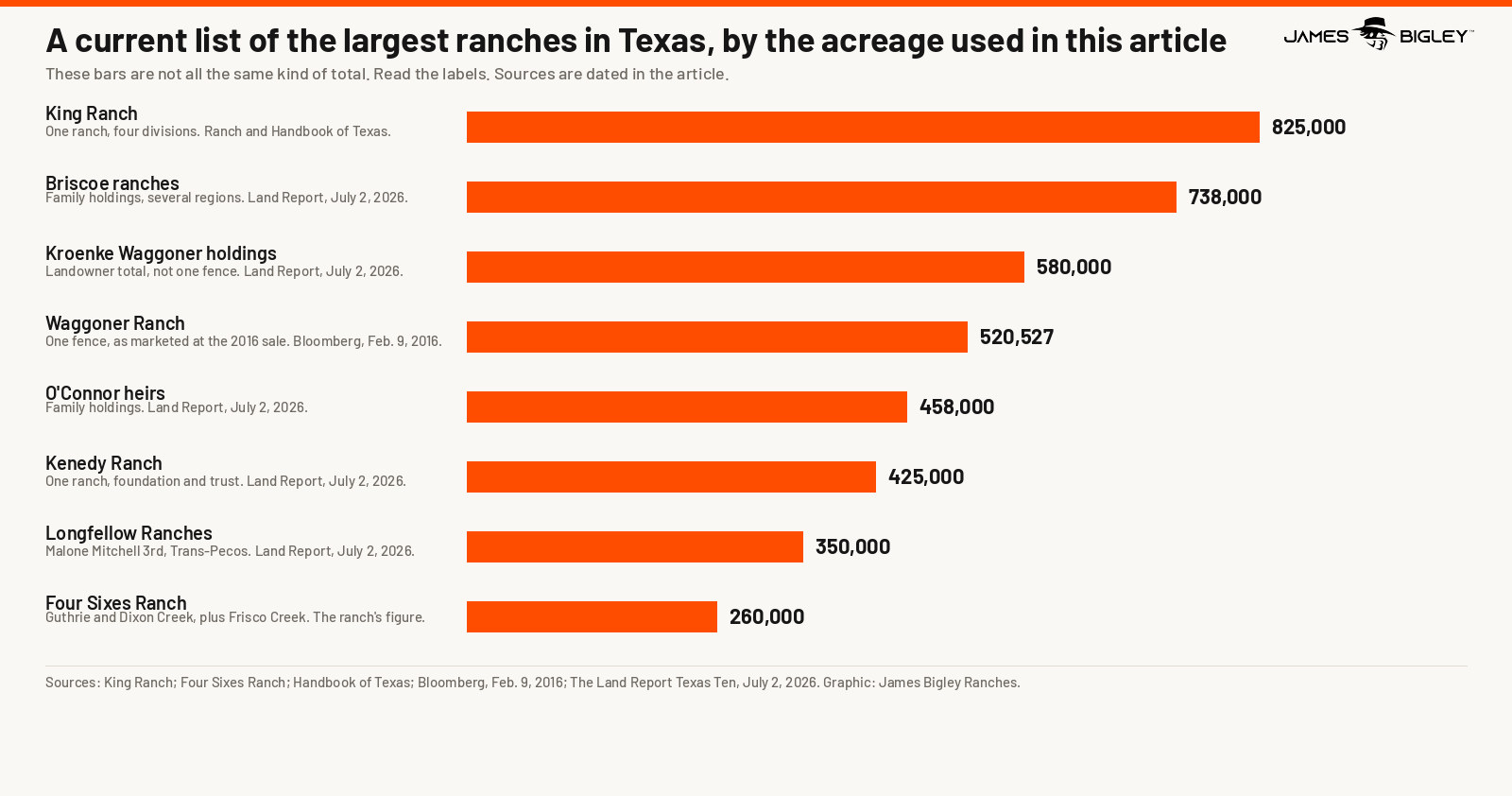
Here is a largest ranches in Texas list drawn from the ranches’ own figures, the Handbook of Texas, Bloomberg’s write-ups of the Waggoner Ranch listing in 2015 and the sale in 2016, and The Land Report’s Texas Ten. The later Land Report list ran on July 2, 2026. Some April 15, 2025, figures are still here, dated, where they still help. Each number is tagged for what it measures. Acreage moves when land changes hands.
Contents: How this list was built · At a glance · Biggest ranch in Texas · Largest under one fence · Other large ranch holdings · Largest landowners who are not ranches · Brewster Ranch · What was larger in the past · What the numbers mean · Q&A
How this list of the largest ranches in Texas was built
If a place is on the ranch list here, it’s a working livestock ranch, or an old one still run that way. Texas Pacific Land Corporation holds more Texas acres than King Ranch. It’s a Permian land, water, and energy company, not a cattle outfit. Caddo Sustainable Timberlands is the biggest timberland owner in the state. You’ll find both later, under landowners, so they don’t pad the ranch numbers.
Acreage comes in more than one flavor. The table flags which kind you’re looking at.
- One named ranch, even if the divisions don’t all touch
- Family or heir holdings, which can cover more than one ranch
- Land behind one fence, where the pastures connect
When a ranch and a landowner list don’t agree, both numbers are here, with the source on each. Older “top ten” figures that can’t be tied to a current primary source were left out.
The largest ranches in Texas at a glance
| Ranch or holding | Acres | What the number is | Source |
|---|---|---|---|
| King Ranch | 825,000 | The ranch, in four South Texas divisions | King Ranch and the Handbook of Texas |
| King Ranch heirs | 836,000 | The heirs’ Texas landholdings | Land Report, April 15, 2025, and July 2, 2026 |
| Briscoe ranches | 738,000 | Family ranch holdings in several regions | Land Report, April 15, 2025, and July 2, 2026 |
| Waggoner Ranch | 520,527 | The ranch behind one fence, as it was marketed at the 2016 sale | Bloomberg, February 9, 2016 |
| Waggoner Ranch (2016 sale) | about 535,000 | The one-fence acres plus additional land included in the sale | Bloomberg, February 9, 2016 |
| Stan Kroenke, Waggoner holdings | 580,000 | A landowner total, not a one-fence survey | Land Report, July 2, 2026 |
| Kenedy Ranch | 425,000 | The ranch, held by the Kenedy foundation and a related trust | Land Report, April 15, 2025, and July 2, 2026 |
| O’Connor heirs | 458,000 | Family ranch holdings on the coastal plain | Land Report, July 2, 2026 |
| Longfellow Ranches | 350,000 | Malone Mitchell 3rd’s ranch holdings in the Trans-Pecos | Land Report, July 2, 2026 |
| Four Sixes Ranch | 260,000 | The Guthrie and Dixon Creek ranches, with a third division at Frisco Creek | Four Sixes Ranch |
Jeff Bezos’s West Texas ranchland comes in at 462,000 acres on The Land Report’s April 2025 and July 2026 lists, which puts it ahead of the Kenedy Ranch. It’s treated below as a landholding. It isn’t a historic cattle company of the same kind. Mike Smith’s 323,000 acres showed up on the April 2025 list and are dated there. He is not on the July 2, 2026, Texas Ten.
This table may be reused under a CC BY 4.0 license, with credit to James Bigley Ranches and the sources named in the columns.
What is the biggest ranch in Texas?
The King Ranch is the biggest ranch in Texas. The ranch and the Handbook of Texas both put it at 825,000 acres. Almost 1,300 square miles. Larger than Rhode Island.
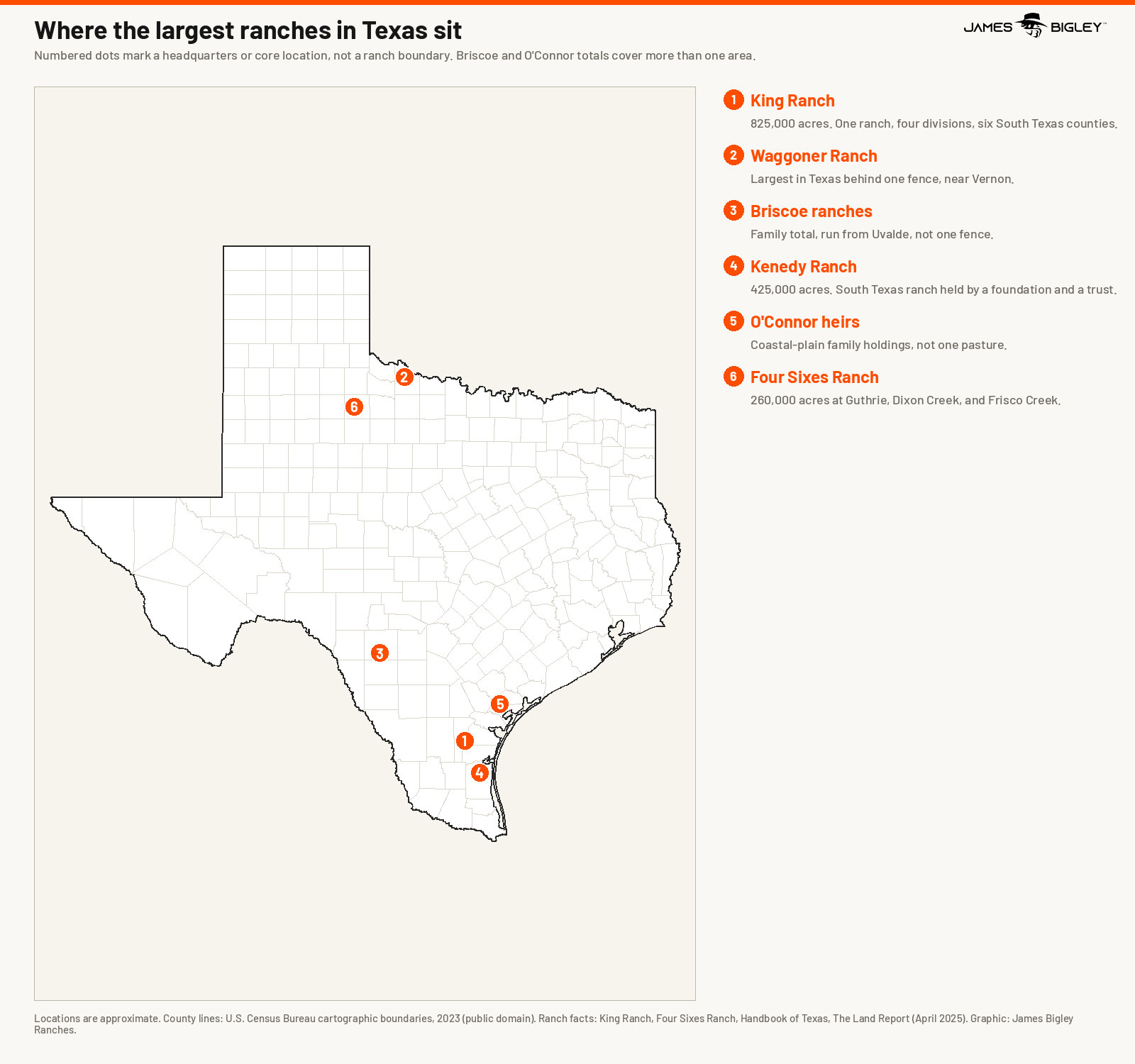
Those acres don’t all join. The ranch is run as four divisions: Santa Gertrudis, Laureles, Norias, and Encino, in Brooks, Jim Wells, Kenedy, Kleberg, Nueces, and Willacy counties. Norias and Encino sit apart from the other two.
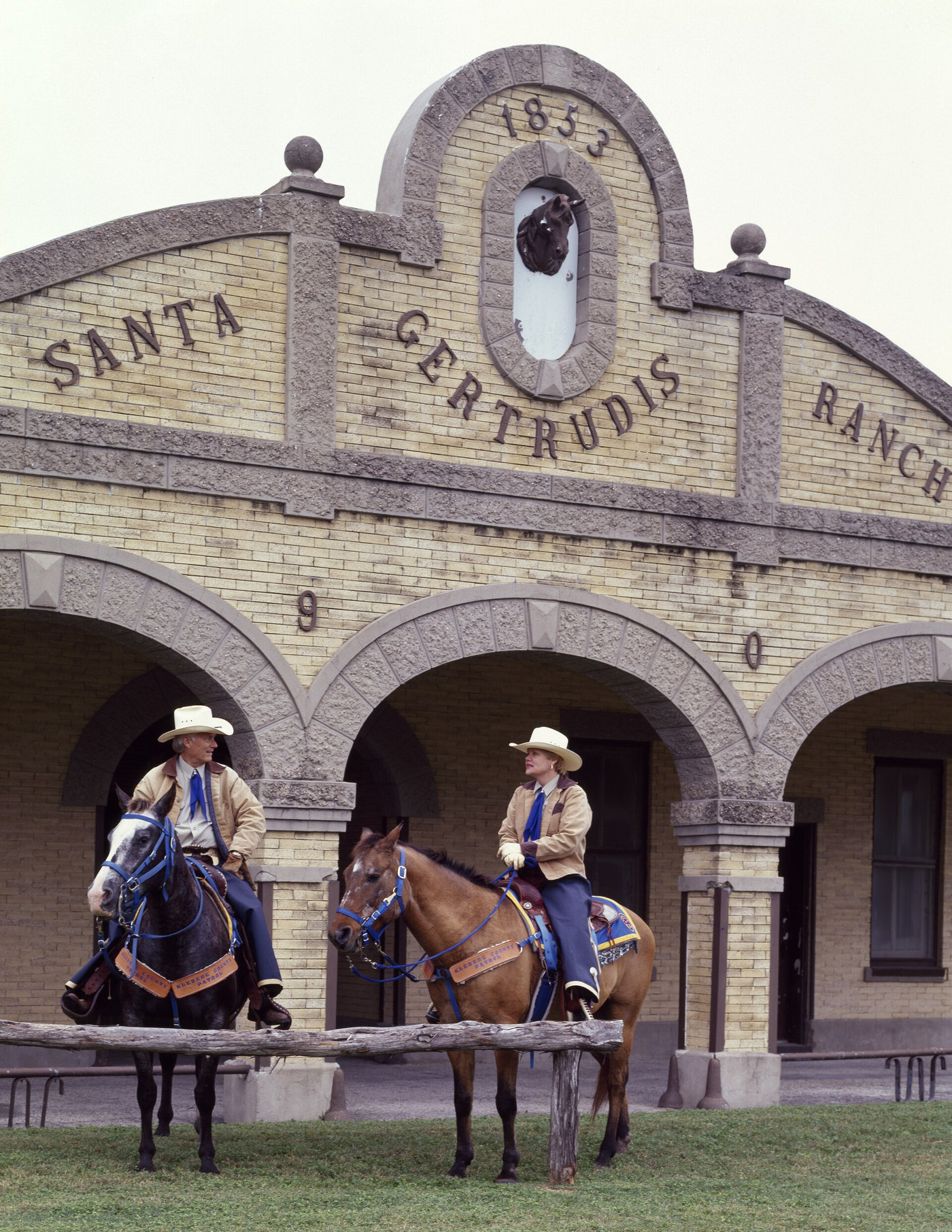
Richard King and Gideon K. Lewis first ran cattle on Santa Gertrudis Creek in 1852. The title work started a year later. They bought the 15,500-acre Rincón de Santa Gertrudis grant in Nueces County, then added the 53,000-acre Santa Gertrudis de la Garza grant. Lewis died in 1855. King bought out his share. Mifflin Kenedy, King’s old partner from the riverboats, took an interest in 1860. They split in 1868, and Santa Gertrudis stayed with King.
King kept buying South Texas land for the rest of his life. He died on April 14, 1885.
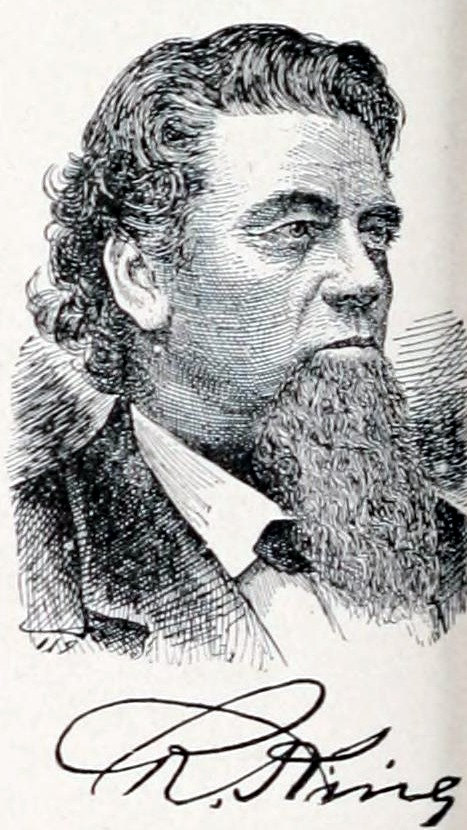
His widow, Henrietta, kept the ranch lawyer, Robert Justus Kleberg Sr., on as manager. Kleberg later married their daughter Alice. The Running W brand was already in use in the 1860s. It was registered on February 9, 1869, and it’s still the ranch brand.
The first cattle were Longhorns, a lot of them bought in Mexico. King added Brahman bulls in 1872. Shorthorns and Herefords came in during the 1880s. Crossing Brahmans with Shorthorns produced the Santa Gertrudis, recognized as a breed by the U.S. Department of Agriculture in 1940. The ranch also bred Quarter Horses and Thoroughbreds. Assault won the Triple Crown in 1946. The Texas headquarters divisions are a National Historic Landmark.
In April 2025, and again on July 2, 2026, The Land Report put King Ranch heirs at 836,000 acres. That’s 11,000 more than the ranch’s own 825,000. The ranch uses 825,000 for King Ranch itself. The 836,000 is how The Land Report counted the heirs’ Texas holdings.
There’s more going on there than grass. The ranch farms, runs hunting, and has a long oil-and-gas history on the place. Humble Oil, now ExxonMobil, completed the first well there in 1939. Tours are still offered. For the XIT comparison, and why 825,000 acres was never the high-water mark in Texas ranch history, see XIT, the Real Largest Ranch.
The largest ranch in Texas under one fence
The Waggoner Ranch is the largest ranch in Texas behind one fence. Stan Kroenke agreed to buy it in February 2016. Bloomberg reported then that the ranch was marketed as measuring 520,527 acres within one fence, and that additional acreage in the sale brought the total to about 535,000. The asking price had been $725 million. Terms of the purchase were not disclosed.
Bryan Gruley got there first, in a July 21, 2015, Bloomberg piece on the listing. He had the ranch at 510,527 acres, across six counties, still called the largest in the United States within a single fence, and listed at $725 million. The Land Report used 510,527 when it wrote up the 2016 sale. The one-fence figure used here is 520,527, from Bloomberg’s February 9, 2016, purchase story. The earlier 510,527-acre count is noted because the two don’t match.
A few other dated figures sit next to those. The Handbook of Texas, writing about the ranch as it stood in 1991, said more than 520,000 acres in six counties: Wilbarger, Baylor, Wichita, Archer, Knox, and Foard. Then, on April 15, 2025, The Land Report called it a 569,000-acre ranch. That later figure is here as a Land Report note. It isn’t the one-fence total.
On the July 2, 2026, Texas Ten, The Land Report listed Stan Kroenke at 580,000 acres and wrote that Kroenke Ranches continues to grow its Waggoner Ranch holdings. Treat 580,000 as a landowner total. It is not a new official one-fence survey. It hints that land has been added since 2016, but the report doesn’t itemize a new tract.
The outfit goes back to the early 1850s. Daniel Waggoner and his son W. T. (Tom) Waggoner moved a herd of 242 cattle and six horses into Wise County, traveling with a fifteen-year-old enslaved boy. By the early 1880s the range ran about thirty miles, from China Creek to the Pease River. They later leased grass in the Big Pasture, on the Comanche and Kiowa reservation north of the Red River, then bought Texas land as the open range closed. Around 1866 they dropped an earlier D61 brand for the 3Ds, three Ds in reverse, a mark meant to be hard for rustlers to change.
By 1900 the herd was up to about 60,000 cattle. Oil came in at Electra in 1911, and the family added production and refining to the cattle business. Main headquarters settled at Zacaweista, south of Vernon. The ranch is also known for Quarter Horses. E. Paul Waggoner bought Poco Bueno as a yearling, and that horse became the foundation sire of the ranch’s program.
After years of family conflict, a court ordered the ranch sold. Kroenke bought it in 2016. The Handbook of Texas says he vowed to keep it under one fence. A fuller history is on Waggoner Ranch: A Legacy of Land, Oil and Cattle. For how Waggoner compares with other big contiguous ranches in the United States, see The Largest Contiguous Ranches in the US.
Other large Texas ranch holdings
The next ranches and ranch families can be sourced from The Land Report’s Texas Ten, or from the ranch itself. They aren’t all one fence, and they aren’t all one property.
The Briscoes, 738,000 acres
The Briscoe family holds 738,000 acres of Texas ranchland, according to The Land Report. That figure is the same on the April 15, 2025, list and the July 2, 2026, Texas Ten. It’s a family total. It is not a single ranch behind one fence. The operation is run from Uvalde. The holdings started on the Catarina Ranch in South Texas and later reached west into the Trans-Pecos and north into the Rolling Plains.
In 2021 the family added 41,077 acres from the old Matador, the Tee Pee City / Lucky Knob division, bought from Koch Industries in Motley and Cottle counties, with about ten miles of the Middle Pease River. Dolph Briscoe Jr., who expanded the ranches, was governor of Texas from 1973 to 1979. Dolph “Chip” Briscoe III oversees the land today, according to The Land Report.
An older figure of 640,000 acres still turns up in unsigned lists, including the 2023 version of this page. It isn’t used here as a current number.
Kenedy Ranch, 425,000 acres
The Kenedy Ranch is 425,000 acres in The Land Report’s April 2025 and July 2026 lists. Mifflin Kenedy, a former steamboat captain, was Richard King’s partner before he built his own South Texas ranch. The two men were in business together on the King Ranch from 1860 to 1868.
The ranch is now owned by the John G. and Marie Stella Kenedy Memorial Foundation and the John G. Kenedy Jr. Charitable Trust. The historic headquarters at Sarita, the seat of Kenedy County, is now a museum, according to The Land Report. This is one named ranch, held by those two related organizations. It isn’t a scattered family portfolio in the same sense as the Briscoe or O’Connor totals.
O’Connor heirs, 458,000 acres
The O’Connor heirs hold 458,000 acres, according to The Land Report’s July 2, 2026, Texas Ten. The same list put them at 410,000 acres in April 2025. Thomas O’Connor arrived on the Texas Gulf Coast from County Wexford, Ireland, in 1834. He signed the Goliad Declaration of Independence and fought at San Jacinto. The Land Report writes that by the end of his life he owned more than 500,000 acres. His descendants still run land-based businesses on the coastal plain. The 458,000-acre figure is a family total. It isn’t a claim that one pasture is that large.
Longfellow Ranches, 350,000 acres
Malone Mitchell 3rd is listed at 350,000 acres on The Land Report’s July 2, 2026, Texas Ten, which places him tenth among Texas’s largest private landowners. The Land Report identifies those holdings as the Mitchells’ Longfellow Ranches, in the Trans-Pecos. That’s the current, sourced figure used here for the Longfellow properties. It’s a landowner total, not a claim that the acres all sit behind one fence. Mike Smith’s 323,000 acres, from the April 2025 top 10, dropped off the later Texas Ten.
Four Sixes Ranch, 260,000 acres
The Four Sixes Ranch, also written 6666, puts its land at 260,000 acres. The ranch’s own pages describe two main properties: the headquarters near Guthrie, in King County, and Dixon Creek Ranch, between Panhandle and Borger. A 2021 Land Report account of the sale also included a 9,428-acre Frisco Creek division just south of the Oklahoma line. The three tracts in that inventory were 142,372 acres at Guthrie, 114,455 acres at Dixon Creek, and the Frisco Creek tract, which add up to 266,255 acres. The ranch’s current 260,000-acre figure is the one used here, with the three divisions noted.
Captain Samuel “Burk” Burnett founded the outfit in 1870, when he bought 100 head of cattle wearing the 6666 brand from Frank Crowley of Denton. A group led by Taylor Sheridan bought the ranch in a sale that closed in early 2022, after the Burnett family had held it since 1870. The deeper history, including the horse program, is on Four Sixes Ranch: A Deep Dive into its Rich Legacy.
Largest Texas landowners who are not on the ranch list
The Land Report ranks the largest private landowners in Texas. That is not a ranch list, and the July 2, 2026, Texas Ten shows why.
Texas Pacific Land Corporation sits at 882,000 acres, more than any other private owner on that list. The 2026 write-up puts the land, water, and energy holdings in 22 Texas counties. Back on April 15, 2025, the same company was at 873,000 acres in 19 counties. The land traces to the old Texas and Pacific Railway grant. Nobody is running a cow outfit at that scale there.
Caddo Sustainable Timberlands comes in at 831,000 acres on the Texas Ten. That’s the Texas number used here. The same 2026 article mentions a 903,000-acre partnership total, with about 70,000 acres over in western Louisiana. Don’t add those together and call it Texas timber. Caddo is the largest timberland owner in the state, mostly in East Texas. Trees, not cattle.
A few other big owners belong in any honest look at scale in Texas, even if they aren’t a single old brand.
- Brad Kelley: 635,000 acres on the July 2, 2026, Texas Ten, after he sold the largest part of Brewster Ranch. The April 2025 list had him at 586,000.
- Jeff Bezos: 462,000 acres in Culberson and Hudspeth counties on both the April 2025 and July 2026 lists. Locals have long called that West Texas place the Corn Ranch. Blue Origin’s launch site is there. The company calls it Launch Site One.
- Mike Smith: 323,000 acres on the April 2025 top 10, including ranchland and the Flat Top division of the old Swenson Ranch. He isn’t on the July 2, 2026, Texas Ten.
You can own more land than a famous ranch and still not be the biggest ranch in Texas. King Ranch is.
A big West Texas ranch that is no longer private
Brewster Ranch used to turn up on lists of the largest ranches in Texas, often at a little more than 400,000 acres. It doesn’t belong on a current private list.
The Texas General Land Office bought the 353,785-acre ranch from Brad Kelley’s Texas Mountain Holdings. The sale closed on October 24, 2024. The ranch had been listed at $245,678,330. The GLO announcement did not state a sale price. The Land Report later reported $164,600,000, or about $465 an acre. James King and Harrison King of King Land & Water had marketed the place. At its height, The Land Report says, Brewster Ranch totaled 422,952 acres, before Horse Mountain, Tesnus, and YE Mesa were sold as separate tracts.
The land is in Brewster County, in the Big Bend country. It borders Big Bend National Park, Black Gap Wildlife Management Area, and the Rio Grande Wild and Scenic River. It is now state land, not a private ranch.
What was the largest ranch in Texas history?
Nothing on the current list is as large as the XIT once was. Texas used about 3 million acres of Panhandle land to pay for the State Capitol. The XIT ran some 220 miles along the New Mexico line and took in all or part of ten counties. Cattle ran there from 1885 to 1912. The owners sold the land a tract at a time. The last parcel sold in 1963.
A current list of the largest ranches in Texas and a history of the XIT shouldn’t be the same article. The XIT was the giant. It doesn’t exist at that size now. The full account is here.
Other famous names have shrunk too. The Y.O. Ranch, which older listicles sometimes still rank in the top five, was a very large Kerr County ranch in its heyday. It has been broken up. It doesn’t belong on a current list of the largest ranches in Texas.
What these acreage numbers mean if you are looking at land
Texas is a private-land state. The Texas A&M Natural Resources Institute has put the privately owned share at about 95 percent. That’s why these big ranches matter. Most of the state’s land is in private hands, and almost all of its ranch country is too.
Size is only one fact. King Ranch is larger than Waggoner, but it’s four divisions, not one fence. The Briscoe total is larger than Waggoner, but it’s a family of ranches, not a single property. Kenedy, Longfellow, and the Four Sixes are large named ranches with their own histories. If you’re comparing tracts in the thousands of acres, not the hundreds of thousands, you’re still up against the same problems these places had to solve. Water. Access. Fence lines. Minerals. And whether the acres actually join.
Acreage also moves. Brewster Ranch left the private list in 2024. Land Report totals change from year to year. Any list of the largest ranches in Texas is a snapshot. The sources behind this one were checked in November 2026.
Q&A
What is the biggest ranch in Texas?
The King Ranch is the biggest ranch in Texas. The ranch and the Handbook of Texas put it at 825,000 acres, in four divisions across six South Texas counties.
What are the largest ranches in Texas right now?
A current, sourced list starts with King Ranch at 825,000 acres. Next are the Briscoe family’s ranches at 738,000 acres, the Waggoner Ranch at 520,527 acres under one fence (about 535,000 acres in the 2016 sale), the Kenedy Ranch at 425,000 acres, the O’Connor heirs at 458,000 acres, Longfellow Ranches at 350,000 acres, and the Four Sixes Ranch at 260,000 acres. The Briscoe, O’Connor, and Longfellow figures are family or landowner holdings. Waggoner is the largest under one fence. The Land Report’s July 2, 2026, Texas Ten lists Stan Kroenke’s Waggoner holdings at 580,000 acres, a landowner total, not a one-fence survey. Texas Pacific Land and Caddo Sustainable Timberlands own more land than some of these ranches, but they are not ranches.
Is King Ranch the largest ranch in the United States?
King Ranch is often called the largest ranch in the United States, and it is the largest in Texas. It is not the largest under one fence, in Texas or in the country. That distinction, in Texas, belongs to the Waggoner Ranch, at 520,527 acres. “Largest in the United States” also depends on whether you count one ranch, one fence, or one owner’s total acres, including land in other states.
Was the XIT Ranch larger than the King Ranch?
Yes. The XIT was about 3 million acres, more than three times the present King Ranch. It was a 19th-century land grant used to pay for the Texas Capitol, and it was sold off. The last land sold in 1963. See the XIT Ranch page.
Why do largest ranches in Texas lists disagree?
They often mix one ranch, a family’s total acres, and a landowner list that includes timber companies and railroad land companies. They also copy old acreage figures after land has been sold. Brewster Ranch and the Y.O. Ranch are two examples. The categories are kept separate here, and the sources are dated.
How much of Texas is privately owned?
The Texas A&M Natural Resources Institute has described Texas as a private-land state, with about 95 percent of the land in private ownership. That is not the same as the share in working farms, ranches, and forests, which the Institute has also measured separately and put lower.