

Water rights are largely ignored when buying land and ranches, I would argue that it is one of the most important parts of negotiating a land deal. Water is the new oil, not just here in Texas, but U.S wide.
— James Bigley, James Bigley Ranches
This article covers groundwater ownership, the rule of capture, and severing water from land. For a general overview of Texas water rights law, see Understanding Texas Water Rights Law.
Yes. Texas law says a landowner owns the groundwater under their land as real property, but groundwater rights in Texas don't guarantee you any set amount of water, and your local groundwater district can still limit how much you pump. Surface water is a different deal, it belongs to the state, and you need a permit to use most of it.
That split is the first thing I tell buyers when water comes up, and on a ranch water comes up every time. Here's how it works, where the rules come from, and what to check before you buy.
Groundwater rights in Texas: what the law says
The short version is in one statute. Texas Water Code Section 36.002(a) says "a landowner owns the groundwater below the surface of the landowner's land as real property."
That ownership comes with two main rights under Section 36.002(b). You can drill for and produce the groundwater under your land, as long as you don't waste it, maliciously drain other property, or negligently cause subsidence. You also keep any other right the common law gives you.
Then the same section puts up the guardrails. Section 36.002(b-1) says ownership does not entitle you "to the right to capture a specific amount of groundwater." And Section 36.002(d) says it doesn't stop a groundwater district from enforcing well spacing or minimum tract size rules, or from regulating production.
So you own it, but you don't get a number. Keep that in mind when somebody tells you a ranch "comes with" a certain amount of water.
The rule of capture
Texas has followed the rule of capture since 1904. The Supreme Court of Texas adopted it in Houston & Texas Central Railway v. East, where a railroad dug a big well near a homeowner's well and dried it up, and the homeowner lost. The basic idea is you can pump what's under your land, and your neighbor generally can't sue you because your well drew down theirs.
The rule of capture is still the backdrop. Section 36.002(b-1)(2) says the ownership statute doesn't change the common law defenses under the rule of capture.
The Day case: groundwater is owned in place
For years people argued about whether you really owned groundwater before you pumped it. The Supreme Court of Texas settled that in Edwards Aquifer Authority v. Day, decided February 24, 2012.
Burrell Day and Joel McDaniel bought 381.40 acres over the Edwards Aquifer in 1994 to grow oats and peanuts and run cattle. They applied to the Edwards Aquifer Authority for a permit to pump 700 acre-feet a year for irrigation. The Authority granted 14 acre-feet.
The Court held that land ownership "includes an interest in groundwater in place that cannot be taken for public use without adequate compensation." It compared groundwater to oil and gas, which Texas has long treated as owned in place. The Court affirmed the court of appeals and sent the takings claim back to the trial court.
What that means for a buyer: the groundwater is part of what you're buying, like the minerals can be. But the case also shows how regulation works in real life. Owning the water in place didn't get Day the 700 acre-feet he asked for.
Who actually regulates your well
In most of Texas the answer is a groundwater conservation district, usually called a GCD. Section 36.0015 of the Water Code says these districts are "the state's preferred method of groundwater management." Districts are local and the rules change a lot from one to the next.
What a groundwater district can do
Under Section 36.101, a district can make rules limiting groundwater production based on tract size or well spacing. Under Section 36.113, a district requires a permit to drill, equip, operate or complete wells, unless the well is exempt. Districts can also enforce their rules in court, with civil penalties up to $25,000 per day per violation under Section 36.102.
Each district has to adopt a management plan, and the Texas Water Development Board approves those plans. The TWDB keeps a list of districts with contact info, websites and plan dates.
For example, the Real-Edwards Conservation and Reclamation District covers our part of the Hill Country around Rocksprings and Camp Wood. Per the TWDB, it was created in 1959, and its current management plan was approved June 4, 2025.
The domestic and livestock well exemption
This is the one most ranch buyers care about. Under Water Code Section 36.117(b)(1), a district has to exempt a well from permitting if it is used solely for domestic use or for livestock or poultry, and:
- it sits on a tract larger than 10 acres, and
- it is drilled, completed or equipped so it can't produce more than 25,000 gallons a day.
Section 36.117(c) says a district can't restrict production from an exempt domestic or livestock well. A few catches:
- If the water stops being used solely for domestic or livestock use, Section 36.117(d) lets the district cancel the exemption and require a permit.
- Under Section 36.117(f) and (h), a district can still make an exempt house or livestock well follow its spacing rules, and it requires you to register the well, so check your district's rules before you drill.
- Under Section 36.117(j), the exemption doesn't apply to a well supplying a subdivision that needs plat approval under Chapter 232 of the Local Government Code.
The exemption only covers that one kind of use. Irrigation, selling water, or a commercial operation is a different conversation with the district.
Surface water is owned by the state
Creeks, rivers and runoff work differently. Water Code Section 11.021(a) says the water of every flowing river, natural stream and lake, and the storm water, floodwater and rainwater of every river, natural stream, canyon, ravine, depression and watershed in the state, "is the property of the state."
To divert or store state water you generally need a water right from the Texas Commission on Environmental Quality. Owning the creek bank doesn't give you the creek.
The stock tank exemption
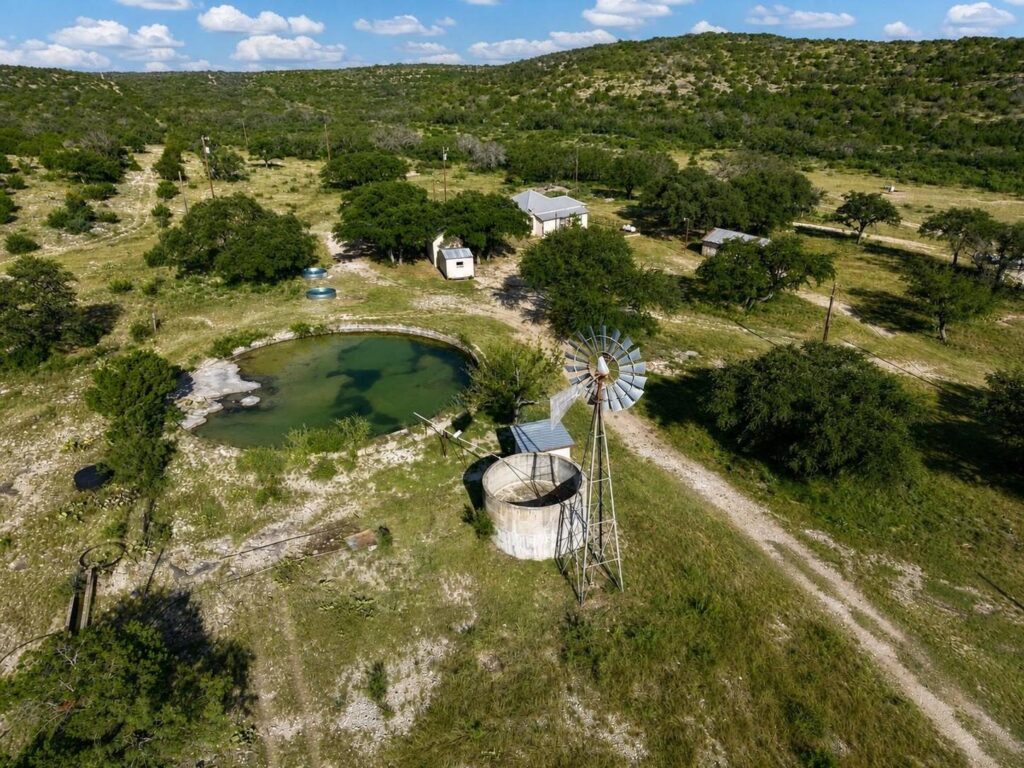
There is a big exception that matters on ranches. Under Section 11.142(a), without a permit you can build a dam or reservoir on your own property with normal storage of not more than 200 acre-feet for domestic and livestock purposes. That exemption doesn't apply to a commercial operation. Section 11.142(b) has a similar 200 acre-foot exemption for fish and wildlife or wildlife management purposes, with its own conditions.
Buying a ranch that has a surface water right
If a ranch comes with a permitted surface water right, ask for a copy of the permit or certificate of adjudication. You can look up authorizations on the TCEQ Water Rights Viewer.
After you close, TCEQ says that if you acquire all or part of a water right, or property with an appurtenant water right, you submit a Change of Ownership Form (TCEQ-10204) with your conveyance documents and a $100 fee. Don't skip that step.
Groundwater rights in Texas: what to check before you buy
Here's my checklist for any ranch where water matters.
1. Find out which groundwater district you're in
Start with the TWDB groundwater conservation district list. Then pull that district's rules and management plan. Look for well spacing, minimum tract size, permit requirements, and any production limits.
2. Pull the well records
Ask the seller for every well location, depth, age and pump info they have. Then check the state records. The TWDB Groundwater Database and the Submitted Drillers Reports database hold driller logs from 2003 on, and the TCEQ Water Well Report Viewer covers reports before 2003. A driller's report can show depth, yield tested and what formations the well hit.
3. Ask how each well is used and permitted
A house and cattle well on a tract larger than 10 acres is likely exempt. An irrigation well or a well that sells water probably needs a district permit. If there's a permit, get a copy and ask the district if it transfers.
4. Read the deed and title commitment for water
Look for any reservation, sale or lease of groundwater or water rights in the deed chain. Your title company and attorney can tell you what they find and what it means for you.
5. Check for surface water rights and stock tanks
If there's a permitted diversion, verify it on the TCEQ viewer and plan for the change of ownership filing. For stock tanks, ask roughly how big they are and what they're used for.
6. Test the water
Have a licensed water well driller or pump installer look at the well, and get a water quality test. TDLR licenses water well drillers and pump installers in Texas.
7. Watch for big plans
If you're buying with plans for irrigation, a subdivision, or selling water, talk to the district before you close. Those uses are where the exemptions stop and permits start.
Why this matters for land value
Water is one of the first things buyers ask about on our ranch listings. A ranch with good wells, a clear exempt status and a stock tank or two is a different property than one with no water and a district that has a long permit process.
Owning the groundwater is a real property right in Texas. Using it is where the local rules come in. Know both before you sign.
For general Texas water rights law (surface and groundwater doctrines), see our Understanding Texas Water Rights Law overview and our water information for landowners. Our land buying checklist covers the rest of what to look at, and if you're looking out west, here's how to evaluate ranch property in Edwards County. You can browse ranches for sale here.
Can groundwater be sold separately from the land?
Yes. In Texas, groundwater under your land is real property, and it can be cut off from the surface estate the same way minerals can: by a deed reservation or a separate conveyance.
Texas Water Code Section 36.002 says a landowner owns the groundwater below the surface as real property. In Edwards Aquifer Authority v. Day (2012), the Texas Supreme Court held that ownership includes groundwater in place, and compared it to oil and gas. In Coyote Lake Ranch v. City of Lubbock (2016), the Court treated a severed groundwater estate like a severed mineral estate: absent a contrary agreement, the groundwater owner has an implied right to use the surface as reasonably necessary to produce the water, limited by the accommodation doctrine.
Landowners can sell, lease, or transfer groundwater rights. Deals are often priced per acre-foot. Markets show up in places like West Texas and the Carrizo-Wilcox, and inside the Edwards Aquifer Authority through administrative permit transfers when authorized withdrawal rights are sold or leased (see the Edwards Aquifer Authority and this Texas Water Resources Institute Q&A). Ownership of the water and the right to pump it are not the same thing. Your local groundwater conservation district can still require permits, set spacing and production limits, and regulate exports under Water Code Section 36.122. A house or livestock well that meets Section 36.117 may stay exempt from permitting, but selling water or irrigating commercially usually does not.
Surface water is different. Under Water Code Section 11.021, water in rivers, natural streams, and lakes is state property and generally needs a TCEQ water right.
A groundwater reservation shows up in the deed chain and title commitment like a mineral reservation. Before you buy, have the title searched for prior water severance or leases, and call the groundwater district for the tract. For more background, see Basics of Texas Water Law from Texas A&M AgriLife Extension and Water Rules Run Deep from the Texas Real Estate Research Center. This is general information, not legal advice. Talk to a Texas water law attorney before you reserve, sell, or buy groundwater rights.
Frequently asked questions
Do I own the water under my land in Texas?
Yes. Texas Water Code Section 36.002(a) says a landowner owns the groundwater below their land as real property. The Supreme Court of Texas confirmed in Edwards Aquifer Authority v. Day (2012) that this interest is owned in place.
Can my neighbor's well dry up mine?
It can happen. Texas follows the rule of capture, adopted in 1904, and the ownership statute doesn't remove the common law defenses under it. Groundwater districts can set spacing and production rules that help manage that.
Do I need a permit to drill a water well on my ranch?
Usually not for a house or livestock well. Under Water Code Section 36.117(b)(1), districts have to exempt wells used solely for domestic or livestock use on tracts larger than 10 acres that can't produce more than 25,000 gallons a day. Check your district's spacing rules before you drill.
Who owns the creek on my property?
The state does. Water Code Section 11.021 makes the water in rivers, natural streams and lakes state property. You need a TCEQ water right to divert most of it, with exemptions like the 200 acre-foot domestic and livestock stock tank under Section 11.142.
Does a surface water right transfer when I buy a ranch?
It can, if the right is appurtenant to the property. TCEQ asks new owners to file a Change of Ownership Form (TCEQ-10204) with the deed and a $100 fee.
Can a seller keep the groundwater when they sell the ranch?
Yes. Like minerals, groundwater can be reserved in the deed or sold separately. Texas A&M AgriLife notes that if the seller reserves the groundwater, the buyer gets the surface but not that water estate. Check the deed and title commitment, then call the district. For a specific deal, use a water law attorney.
Bottom line
You own the groundwater under your Texas ranch, but you don't own a guaranteed amount, and the local district sets the rules for using it. Surface water belongs to the state. Find your district, pull the well records, and read the deed before you buy.
Questions on a ranch you're looking at? Email jb@jamesbigleyranches.com or call 830-609-8056.
Sources
- Texas Water Code ch. 36 (Secs. 36.0015, 36.002, 36.101, 36.102, 36.113, 36.117): https://statutes.capitol.texas.gov/Docs/WA/htm/WA.36.htm
- Texas Water Code ch. 11 (Secs. 11.021, 11.142): https://statutes.capitol.texas.gov/Docs/WA/htm/WA.11.htm
- Supreme Court of Texas, Edwards Aquifer Authority v. Day, No. 08-0964 (Feb. 24, 2012), case page: https://search.txcourts.gov/Case.aspx?cn=08-0964&coa=cossup
- Texas Water Development Board, Groundwater Conservation Districts: https://www.twdb.texas.gov/groundwater/conservation_districts/index.asp
- TWDB, Real-Edwards Conservation and Reclamation District listing: https://www.twdb.texas.gov/groundwater/conservation_districts/gcdinfo3.asp
- TWDB, Groundwater Database and Submitted Drillers Reports: https://www.twdb.texas.gov/groundwater/data/gwdbrpt.asp
- TCEQ, Water Rights: https://www.tceq.texas.gov/permitting/water_rights
- TCEQ, Applying for a Water Right or to Change Ownership: https://www.tceq.texas.gov/permitting/water_rights/wr-permitting/wr_applications.html
- TDLR, Water Well Drillers and Pump Installers: https://www.tdlr.texas.gov/wwd/wwd.htm